
Exercise is essential to maintain physical and mental health: without exercise the sharpness of our minds, our happiness, and our bodily processes deteriorate. Exercise is not just weightlifting, running, or playing competitive sports— there are many ways to stay active if you are able-bodied! Walking with friends, going skating, or joining a beginner intramural team are all ways that you can take care of your health. However, for people who cannot get their heart beating a little faster without expensive equipment or additional support, finding a good way to stay active might be challenging.
While many may not consider it when designing sports programs, community facilities, and private gyms, people experiencing mobility disabilities have the same physical and mental need for exercise as the rest of the population. The social model of disability states that it is not the responsibility of people experiencing disability to become capable of existing in spaces not designed for their accessibility, but for the designers of publicly accessible spaces to keep those with differences in accessibility in mind. For people experiencing physical disability it is even more critical for health to engage in formal exercise: secondary complications associated with often-times sedentary lifestyle of people experiencing disability can be devastating to wellness.
Currently, an overwhelming majority of fitness centres (both private and community centres for fitness) are not accessible to everyone. The equipment available at most fitness facilities does not consider the 1 in 10 Canadians over the age of 15 that have a mobility disability. This means that 2.7 million Canadians may not have access to protect and preserve their mental and physical health. However, the Faculty of Kinesiology, Sport, and Recreation at the University of Alberta offers a facility and program designed with the intention to offer accessible exercise. The Steadward Centre for Personal & Physical Achievement at the University of Alberta has the vision of facilitating adapted physical activity and para sport opportunities for everyone. The Centre directs their attention primarily to innovative programming and fitness opportunities for people experiencing disabilities while simultaneously functioning as a research and education facility.
Programming and Support:
The Steadward Centre offers four main programs to patrons: Adult Fitness and Recreation (AFR), Athlete Development for Parasport, Free2BMe, and Functional Electrical Stimulation (FES). In AFR, people experiencing disability are encouraged and supported in being physically active in the presence of Certified Exercise Physiologists who are trained in Adapted Physical Activity. The Athlete Development for Parasport program facilitates high-performance sports training, led by experienced coaches, in an individualized fashion for each athlete. Children and youth who are experiencing disability are supported in learning physical literacy skills, developing active lifestyles, and gaining independence through the Free2BMe program offered by the Steadward Centre. Finally, the FES program offers physical activity to people who have paralysed or weakened muscle activity as a result of a condition or trauma. There are three types of FES available through the Centre: (1) FES arm cycling, (2) FES leg cycling, and (3) FES arm and leg elliptical. The Steadward Centre is one of four community facilities in the Edmonton area equipped with FES. During the COVID-19 pandemic, at home programming has also been available. This programming allows for a safe, inclusive environment for all people to engage with active lifestyles that improve and sustain physical and mental wellness. Accessibility to exercise resources, spaces, and classes contributes to lower instances of secondary health complications and therefore improves quality of life for people experiencing disability.
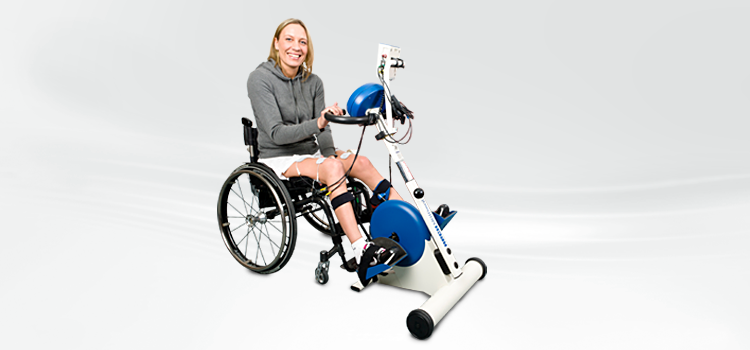
FES bikes use electrodes stuck to the surface of the skin to elicit muscle contraction and therefore enable cycling for persons with neurotrauma or neurodegeneration. FES bike usage also helps to prevent cardiovascular diseases, osteoporosis, and type 2 diabetes.
Exercise is Rehabilitation: People with Neurotrauma and Neurodegeneration
Functional Electrical Stimulation allows people with neurotrauma (spinal cord injury, stroke, etc.) or neurodegeneration (namely multiple sclerosis) to engage in regular physical activity without the cost of physiotherapists. Although exercise offers prevention against secondary complications of a largely sedentary lifestyle common amongst people with neurological disabilities, exercise is more than that when facilitated by FES: it is a form of rehabilitation! FES facilitated cycling has been shown to improve over ground walking in people with spinal cord injury (SCI), stroke, multiple sclerosis (MS), and Parkinson’s disease (PD). Impactful work in the area of neurorehabilitation using FES has been conducted at the University of Alberta, where FES equipment has been available through the Steadward Centre since 1991.
Don’t Stop Here
It may be tempting after reading this article to think that if fitness facilities introduced FES accessibility and offered programming that considers differences in mobility that we would be set and on our way. This is not the case. While the Steadward Centre has made great strides in facilitating exercise for people experiencing physical disability, we must additionally consider people with greater diversity of disability in our community designs. Examples of essential services under the social model of disability include introducing braille equipment labels for people who have vision deficits, adding training for Adapted Physical Activity as a requirement for facility trainers, and increasing availability of adaptive programming as opposed to placing people experiencing disability in beginner programming. Furthermore, this type of facility should not be unique; across the province and the country, more facilities that offer programming to people experiencing disability must develop. If health is considered valuable in Alberta and in Canada facilities like this will be demanded and will be funded. Everyone deserves access to physical activity!
Written By: Jane Porter
Edited By: Erica Kim