WRITTEN BY: Strathcona Place Society, Marms (SPS Member)
Original blog can be accessed at this site.
Many of the famous Code Talkers whose story was fictionalized and memorialized by Hollywood in the movie Windtalkers were actually Cree soldiers from Alberta, Saskatchewan and Manitoba.
Indigenous soldiers again served as snipers and scouts in the Second World War, as they had during the First World War, but they also took on interesting new roles. One unique example was being a “Code Talker.” Men like Charles Checker Tompkins of Alberta translated sensitive radio messages into Cree so they could not be understood if they were intercepted by the enemy. Another Cree-speaking “Code Talker” would then translate the received messages back into English so they could be understood by the intended recipients (Source).
More than one indigenous soldier was medaled for heroic efforts on behalf of Canada. The monument stands testimony to the courage of sharpshooter Frances Pegahmagabow.
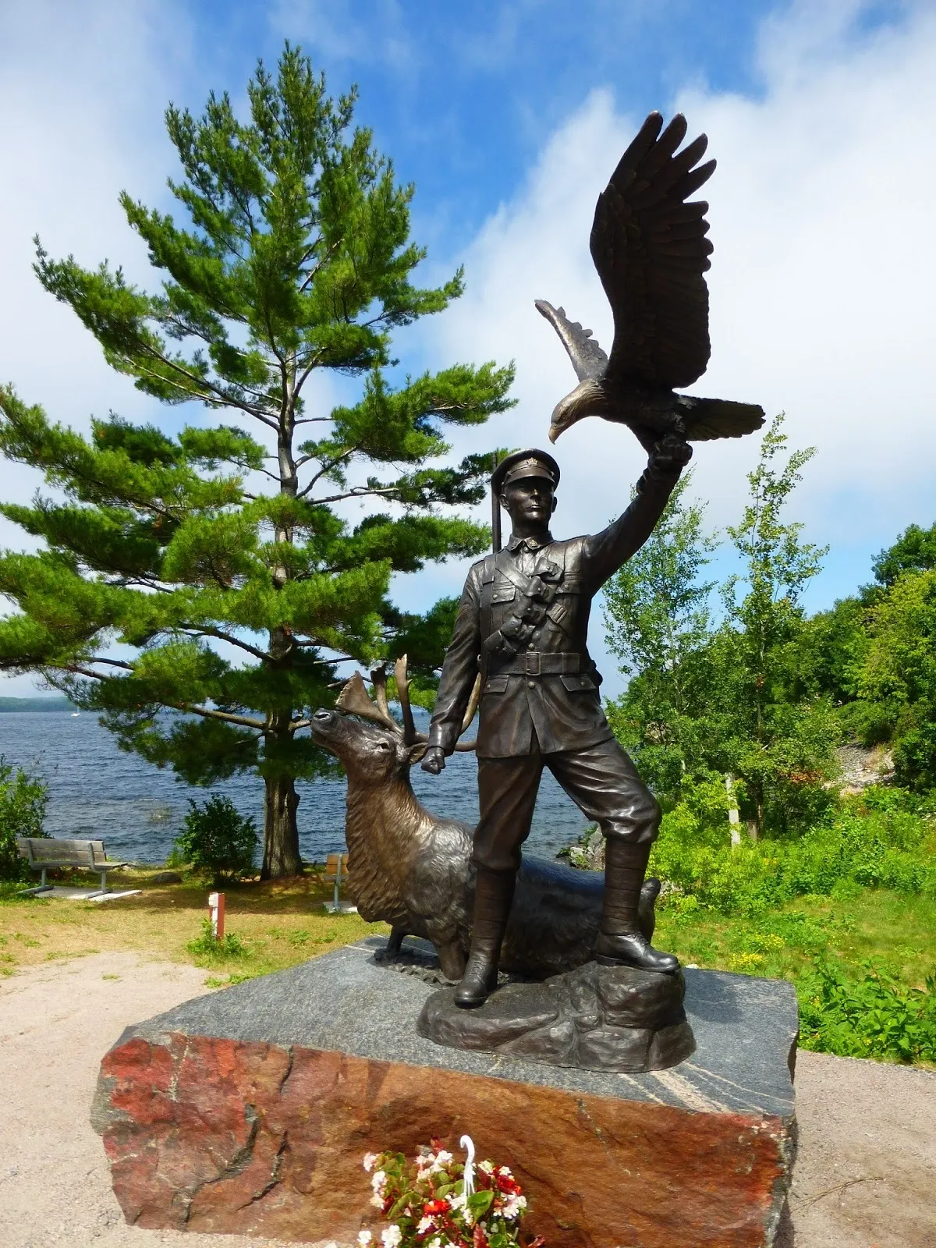
A bronze likeness of Company Sergeant-Major (CSM) Francis Pegahmagabow was unveiled June 21, 2016, on National Aboriginal Day in Parry Sound, Ontario, just a short drive from Sgt Pegahmagabow’s birthplace at Wasauksing First Nation. The event featured a strong military presence, including Lieutenant-General Marquis Hainse, Commander of the Canadian Army, and a 50-soldier guard of honour.
The monument was created by Tyler Fauvelle, a sculptor based in Sudbury, Ontario. The statue, which stands approximately 10 feet tall, depicts CSM Pegahmagabow in his wartime uniform with an eagle above and a caribou at his side.
The caribou represents his clan, hunting, and sustenance. The caribou pushes up through the water, a sign of Pegahmagabow’s battle through the depths of war, a symbol of the spirit of his people crossing the ocean with him and of their own struggle to emerge from the depths of injustice.
The rock at his feet resembles the far-away Canadian Shield. Even on foreign soil that never knew his ancestors, he was grounded by his home, by the culture written in his heart.
The eagle is the sign of the Thunderbird – the powerful, mystical protector, the first messenger, the prayer carrier. It calls to mind Pegahmagabow’s dangerous role as a scout and messenger and all the prayers rising up from the battlefield. It must have seemed like the end of the world and migizi was needed. The eagle’s acute vision represents Pegahmagabow’s – his sharp sniper’s eye, but also his figurative vision, as a man who saw the vital importance of preserving his people’s language and traditions and of advocating for Indigenous rights. It echoes the eagle feathers in his Chief’s headdress, reminding us of his lineage and that he twice served as Chief of Wasauksing First Nation. The shock of war followed Francis Pegahmagabow home. Thunder, artillery and the Thunderbirds would forever be linked in his mind and spirit.
Francis Pegahmagabow is shown in the Canadian Expeditionary Force uniform he would have worn, with the rifle that his own life and the lives of his fellow soldiers depended on. His pose is noble, uplifted, alluding to his bravery and to his spiritual strength.
The small medicine pouch in his hand, Francis Pegahmagabow said he never knew what was in the pouch he was given. There is no doubt that it was part of the strong sense of spiritual protection that sustained him through some of the Great War’s most horrific battles.
The entire concept came to Tyler in a dream. Although it took months to sculpt, he had the honour of speaking often with members of Francis Pegahmagabow’s family and it never really changed much from his first dream.
CSM Pegahmagabow is revered for being the most decorated Indigenous Canadian to fight in the First World War. He is one of only 38 Canadians to have earned the Military Medal (MM) with two bars, each representing an act of valour. He earned the first in 1917 at the Battle of Passchendaele, the successful assault on a ridge in Belgium held by the Germans. He earned the second in 1918, during what would prove to be the final hundred days of the war, by charging into heavy enemy fire to retrieve ammunition for his comrades.
Following his wartime service, CSM Pegahmagabow returned home in 1919 and continued to lead by example as a member of the Non-Permanent Active Militia (now the Canadian Armed Forces Army Reserve) and through political activity in his community, where he served as chief and councillor before his death in 1952.
Please click here to learn more about the Canadian indigenous war heroes.
 Campus UNICEF